
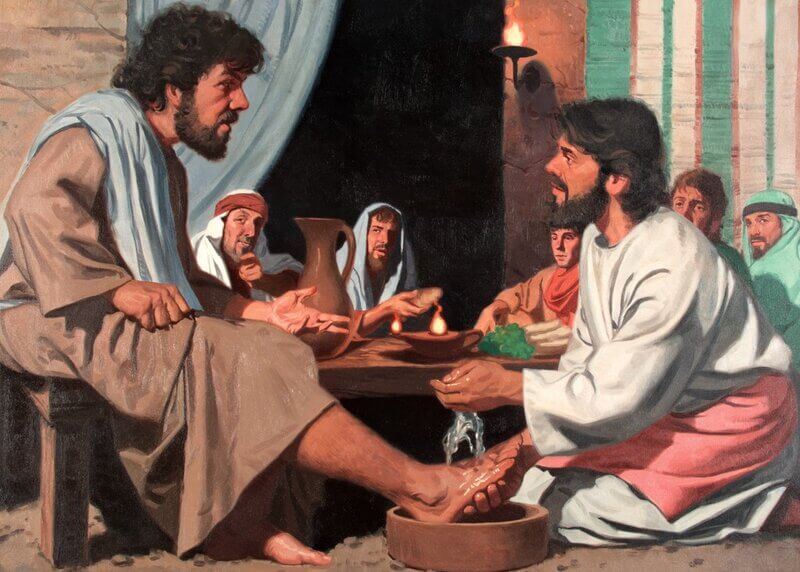
Jesus washes his disciple’s feet
Before Jesus was arrested and executed, he spent his last evening teaching and encouraging his disciples. And on this night before he left them, he wanted them to learn an important lesson. So, he washes their feet. What was the lesson he was teaching by this?
Jesus’ powerful demonstration
Jesus taught his disciples a number of different ways: by sermons, parables, and allegories. But he knew that people don’t always learn well just by passively listening to sermons. So, on occasion he used physical demonstrations, which were powerful and effective. And these demonstrations usually had at least two levels of meaning: an immediate earthly application and a spiritual one.
On this special occasion before his death, he wanted to demonstrate a lesson that they would be sure to remember:
The evening meal was in progress, and the devil had already prompted Judas, the son of Simon Iscariot, to betray Jesus. Jesus knew that the Father had put all things under his power, and that he had come from God and was returning to God; so he got up from the meal, took off his outer clothing, and wrapped a towel around his waist. After that, he poured water into a basin and began to wash his disciples’ feet, drying them with the towel that was wrapped around him. (John 13:2-5)
Most people in first century Israel walked wherever they went. Although people also wore covered shoes, they wore mostly sandals. And walking the dusty roads, their feet got dirty. So, whenever guests would arrive at someone’s house, it was the custom for the guests to remove their sandals and the servant of the house to wash their feet. So, Jesus took the role of a servant on that night and performed the mundane and unpleasant task of washing the disciple’s feet.
Peter protests
But Peter protested:
He came to Simon Peter, who said to him, “Lord, are you going to wash my feet?” (John 13:6)
Peter didn’t understand what Jesus was doing, either the immediate application or the deeper spiritual lesson. Like most people, then and today, he thought that less important people should be the servants, not the greater. More important people should be higher than others and should receive special treatment. Peter knew Jesus to be the Lord and so a lord should not serve but others should serve him.
Jesus replied, “You do not realize now what I am doing, but later you will understand.” “No,” said Peter, “you shall never wash my feet.” Jesus answered, “Unless I wash you, you have no part with me.” (John 13:7-8)
Jesus is patient with Peter and knows that he wouldn’t understand this completely. But after Peter still resists, Jesus then gets serious with him and tells him the raw truth. And he expresses it in an allegory: unless Jesus washes Peter’s feet, he can have no part with him. Spiritually, this meant that unless Jesus cleanses Peter of his sins, Peter can’t have any fellowship with Jesus. And ultimately, Peter couldn’t receive any of the Lord’s spiritual blessings—none of his promises would apply to him.
“Then, Lord,” Simon Peter replied, “not just my feet but my hands and my head as well!” (John 13:9)
Jesus washes Peter’s feet
So, Peter makes the wiser choice to let Jesus wash his feet. But he still doesn’t understand the depth of what Jesus was teaching. Jesus wants to wash people’s souls from top to bottom. Without this depth of washing, every person is unredeemed and remains in his sins.
Jesus answered, “Those who have had a bath need only to wash their feet; their whole body is clean. And you are clean, though not every one of you.” For he knew who was going to betray him, and that was why he said not every one was clean. (John 13:10-11)
But those who repent and believe in Jesus are spiritually clean and have a new life. God gives Christ’s righteousness to them as a gift, received through faith. God’s very nature now dwells in them. They are fully “clean” because they have taken a bath in God’s grace.
According to Jesus’ statement, the disciples believed in him and were therefore clean at that time. The exception to that was Judas. He was not clean but had a dark heart. He hadn’t turned to God in faith to receive his forgiveness and mercy. By his choice he lived apart from God’s grace. But the amazing thing was that Jesus still washes his feet, even when afterwards he would leave to betray him. Jesus clearly loved his enemies.
Jesus’ command to wash feet
When he had finished washing their feet, he put on his clothes and returned to his place. “Do you understand what I have done for you?” he asked them. “You call me ‘Teacher’ and ‘Lord,’ and rightly so, for that is what I am. Now that I, your Lord and Teacher, have washed your feet, you also should wash one another’s feet. (John 13:12-14)
Up to this time the disciples may have thought this was another one of Jesus’ teachings that they could think about and take some time to digest. They enjoyed learning under Jesus because he was such a great teacher. But he didn’t do this as an academic exercise, and not even as a demonstration of piety and sacrifice. Now he tells them plainly: he gave this as a command for them to obey. They are now to do the same as he did, and with each other:
I have set you an example that you should do as I have done for you. Very truly I tell you, no servant is greater than his master, nor is a messenger greater than the one who sent him. Now that you know these things, you will be blessed if you do them. (John 13:15-17)
His demonstration was a pattern they were to follow. He was the Teacher, and they were the students. As hard as it was to do, as his students they were to emulate him. And not just in a literal and legalistic way, but in spirit and in sincere love, serving people that they didn’t even like. And not just at special times, but all the time, as a way of life. This is what consumed Jesus’ thoughts and concerns before he was to die the next day.
They were to look for opportunities to minister to their brothers and sisters in the faith, as well as to those outside the faith. And his promise was that those who would follow his example would be blessed and rewarded by God.
Servants of all
Over the previous three years, Jesus had taught his disciples the difference between worldly and heavenly kingdoms. The thinking that characterizes worldly kingdoms is the thinking that Peter started with—the greater and higher dominate or lord it over the lesser and lower. But in God’s kingdom, it’s the opposite. Those who want to be great must become servants:
Jesus called them together and said, “You know that the rulers of the Gentiles lord it over them, and their high officials exercise authority over them. Not so with you. Instead, whoever wants to become great among you must be your servant, and whoever wants to be first must be your slave— just as the Son of Man did not come to be served, but to serve, and to give his life as a ransom for many.” (Matthew 20:25-28)
Of course, Jesus wasn’t commanding us to dismantle all levels of earthly authority. But whoever wants to be truly great in God’s kingdom must put aside any worldly greatness and become what the world thinks is lowly. We must give up our pride, our titles, and our status, and willingly put other people above ourselves. This is opposite of how people normally think and live. So, those who are truly great will wash others’ feet. They will follow Christ’s example who didn’t come to be served but to serve.
God’s humility
As Paul wrote to the Philippian believers, Christ’s servanthood is the supreme example for the whole Christian church:
In your relationships with one another, have the same mindset as Christ Jesus: Who, being in very nature God, did not consider equality with God something to be used to his own advantage; rather, he made himself nothing by taking the very nature of a servant, being made in human likeness. (Philippians 2: 6-7)
It’s amazing that God, the supreme authority and ruler of the universe, willingly humbled himself. He left his high position in heaven and came to earth in human form as Jesus Christ to become the servant of all. As the God-man, Jesus showed us what true servanthood is. He revealed who God is and what he is truly like.
Washing feet in the early church
How did the early church understand Jesus’ washing the disciple’s feet? The apostle Paul paraphrased Jesus’ teaching when he gave his farewell address to the Ephesian elders:
… we must help the weak, remembering the words the Lord Jesus himself said: ‘It is more blessed to give than to receive.’ (Acts 20:35)
In 1 Timothy, Paul instructed Timothy that only those widows who had “washed feet,” who had a record of good deeds and compassion towards others, should be put on the widow’s list for support:
No widow may be put on the list of widows unless she is over sixty, has been faithful to her husband, and is well known for her good deeds, such as bringing up children, showing hospitality, washing the feet of the Lord’s people, helping those in trouble and devoting herself to all kinds of good deeds. (1 Timothy 5:9-10)
So, “washing feet” came to be known in the early church as a metaphor for following Christ’s example of servanthood and ministering to the needs of other people.
How do we wash one others’ feet?
We all walk in the world and as we do, our feet get dirty. The ways of the world, the temptations, the worldliness, the disappointments, the conflicts, and the hurt can cling to us and weigh us down. After spending so much time outside, we accumulate dirt, and we need our feet washed. We need to be ministered to.
Most cultures no longer practice washing the feet of guests. So, how do we wash one another’s feet today?
Washing feet means ministering to people’s real needs. These needs could be physical, emotional, or spiritual. People need comfort and encouragement. They need wise counsel when in difficult situations. They need to confess their sin and be cleansed of it. And there are countless other ways: helping others, visiting the sick, spending time with someone who is down or depressed. It could be doing someone else’s work when they are tired or ill.
In short, it would be practicing the “one anothers:” to bear one another’s burdens, pray for one another, to be kind and compassionate with one another, and offer hospitality to one another.
So, let’s put aside our pride, wrap ourselves in humility as Jesus did, and serve one another. We will find great joy in doing so, as it’s far more blessed to give than to receive.
Christ in Scripture is listed on Feedspot Top 100 Christian Blogs.



2 thoughts on “Jesus washes his disciples’ feet”
Enjoy the teachings so much. Do you have any pamphlets or books that can be used as bible study material?
Rachel, I don’t have any guides for specific portions of the Bible, but I have authored two books: Interpreting and Applying the Bible, a Non-scholar’s Guide, and Final Judgment and the Goodness of God, How does a Loving God Punish Evil? They’re both available on Amazon.
Blessings, Scott